
Introduction
Every serious web project eventually faces the same architectural question: do we go with a dedicated backend and a modern frontend bridge, or do we go full JavaScript from server to client?
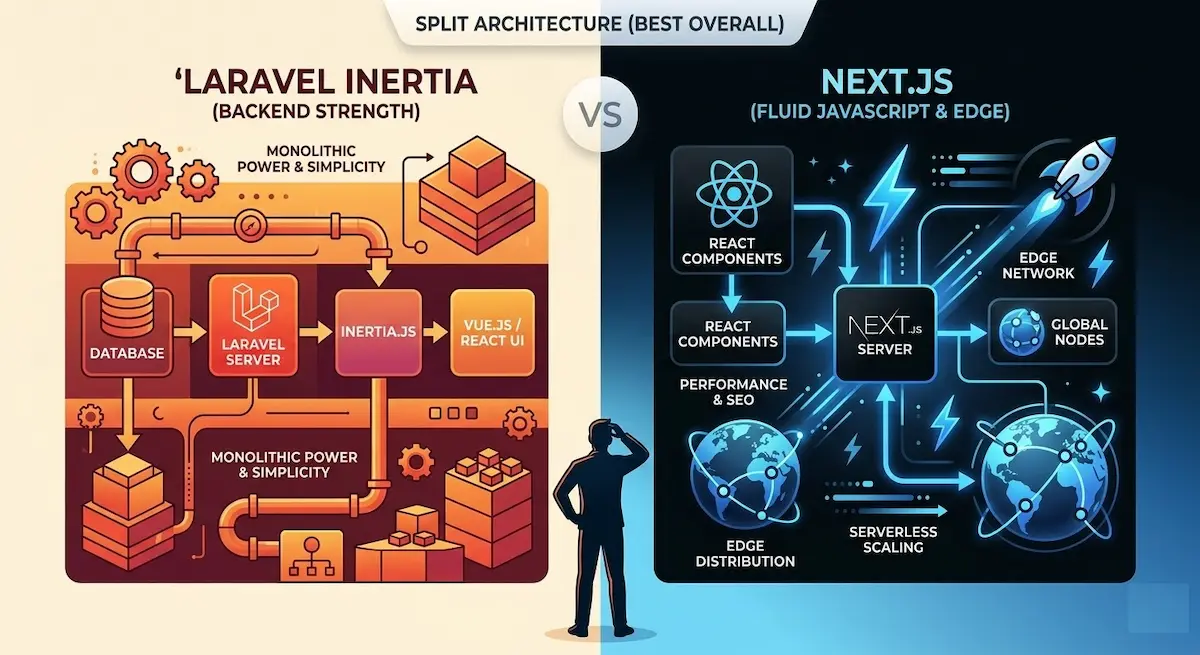
Laravel Inertia.js and Next.js are two of the most capable answers to that question in 2026. Both are production-ready. Both have strong ecosystems. Both can handle complex, real-world applications.
But they are built on fundamentally different philosophies — and choosing the wrong one for your project costs you months.
I've built production applications with both. A fullstack artist platform with Laravel, Inertia.js, and Vue.js. A high-performance template engine with React and Vite that extends naturally into Next.js architecture. This comparison is not theoretical. It's what I learned building real products.
What Is Laravel Inertia.js
Laravel is a PHP backend framework known for its elegant syntax, powerful ORM, and robust ecosystem. Inertia.js is the bridge that connects it to a modern JavaScript frontend — React or Vue — without building a separate API.
Instead of returning JSON from your Laravel controllers, you return Inertia responses that render React or Vue components directly. The result feels like a traditional server-rendered app but behaves like a Single Page Application.
You get Laravel's authentication, authorization, queues, jobs, and database tooling — with a React or Vue frontend that feels native. No API layer to maintain. No token management. Just clean, unified code.
What Is Next.js
Next.js is a React framework built by Vercel that handles routing, server-side rendering, static generation, and API routes within a single JavaScript codebase.
It operates entirely in the JavaScript ecosystem. Your backend logic lives in API routes or server components. Your frontend is React. Everything — routing, data fetching, rendering strategy — is configured within Next.js itself.
In 2026, Next.js 15 with the App Router and React Server Components has matured significantly. It is genuinely powerful for content-heavy, SEO-critical, or globally distributed applications.
The Real Differences
Language and Ecosystem
Laravel Inertia runs on PHP for the backend. If your team knows PHP, or if you're a solo developer comfortable with Laravel, this is a massive productivity advantage. Laravel's ecosystem — Eloquent, Sanctum, Horizon, Telescope — is battle-tested and deeply integrated.
Next.js runs entirely on JavaScript and Node.js. If your team is JavaScript-first, or if you want one language across the entire stack, Next.js removes the context-switching cost.
Neither is superior. It depends entirely on where your existing knowledge lives.
Authentication and Authorization
This is where Laravel wins clearly. Laravel Sanctum, Breeze, and Jetstream provide authentication out of the box — session-based, token-based, OAuth. Role and permission systems like Spatie are one package away.
In Next.js, authentication requires either NextAuth.js, Clerk, or building your own solution. These tools are good, but they add configuration overhead and third-party dependencies that Laravel handles natively.
SEO and Server-Side Rendering
This is Next.js territory. Next.js was built for SEO from the ground up. Static generation, incremental static regeneration, server components, streaming — every rendering strategy is available and configurable per page.
Inertia.js by default renders on the client, which means the initial HTML served to search engines is minimal. You can add server-side rendering to Inertia, but it requires additional configuration and is not as seamless as Next.js handles it natively.
If SEO is critical to your project — a blog, a marketing site, an e-commerce platform — Next.js has a structural advantage.
Developer Experience
Laravel Inertia offers an exceptional developer experience for developers who know Laravel. You write controllers the same way you always have. You return Inertia responses instead of views. Your frontend components receive props directly from your backend. The mental model is simple and elegant.
Next.js developer experience has improved dramatically with the App Router, but it comes with a steeper learning curve. Server components, client components, the distinction between them, caching behavior, and data fetching patterns require significant investment to understand deeply.
Performance
Both can achieve excellent performance when configured correctly.
Next.js has an edge in initial page load for SEO-critical pages due to static generation and server components. Inertia has an edge in subsequent navigation speed because it functions as a SPA after the initial load.
For most business applications, the performance difference is negligible. Architecture decisions matter far more than framework choice at this level.
Deployment
Next.js deploys most naturally on Vercel — zero configuration, global edge network, automatic scaling. It also works on any Node.js server, but Vercel is the path of least resistance.
Laravel deploys on any PHP server — shared hosting, VPS, cloud platforms like Laravel Forge, or containerized with Docker. For Moroccan and MENA region deployments where Vercel's edge network is less optimized, a Laravel VPS deployment can actually outperform Next.js on Vercel for local users.
When to Choose Laravel Inertia.js
Choose Laravel Inertia when:
- Your project requires complex backend logic — roles, permissions, queues, jobs, complex database relationships
- You or your team are already comfortable with PHP and Laravel
- You are building a business application — CRM, admin dashboard, SaaS backend, e-commerce
- Authentication complexity is high
- You want maximum backend control with minimal API overhead
- Your client is a business that needs reliability and long-term maintainability over cutting-edge frontend architecture
When to Choose Next.js
Choose Next.js when:
- SEO is a primary requirement — blog, marketing site, content platform
- Your team is JavaScript-first and wants one language across the stack
- You need fine-grained control over rendering strategy per page
- You are building a content-heavy or publicly indexed application
- You want to deploy on Vercel's global edge network with minimal DevOps
- Your project benefits from React Server Components for data-heavy pages
What I Use and Why
For client projects that involve complex business logic — user management, admin dashboards, dynamic content, e-commerce — I choose Laravel Inertia. The productivity is unmatched when the backend is where the complexity lives.
For SEO-critical products, public-facing platforms, or projects where the JavaScript ecosystem is the right fit, I reach for Next.js.
Dywan Dev itself is built with Next.js because it is a public platform where SEO and content discoverability matter from day one. Chat Rouge Art — the artist platform with a complex admin dashboard, gallery management, and user authentication — was built with Laravel Inertia because the backend complexity demanded it.
The right tool depends on the right project. A senior engineer does not have a favorite. They have judgment.
The Decision Framework
Ask these three questions before choosing:
1. Where does the complexity live?
If it's in the backend — Laravel Inertia. If it's in the frontend or content layer — Next.js.
2. What does your team know?
The best framework is the one your team can execute well under deadline pressure.
3. Does SEO matter from day one?
If yes — Next.js. If it's an internal tool or authenticated application — Inertia's client-side rendering is not a problem.
Conclusion
Laravel Inertia.js and Next.js are both excellent. The question is never which one is better — it's which one is better for this specific project, this specific team, and this specific deadline.
If you are building something complex, authenticated, and backend-heavy — Laravel Inertia will save you weeks. If you are building something public, content-driven, and SEO-critical — Next.js will serve you better.
Understanding both is what separates engineers who follow trends from engineers who solve problems.
At Dywan Dev, every project starts with the right architectural decision for the client's actual needs — not the most popular framework of the moment. If you need a fullstack web application built with the right tools for your business, let's talk.