
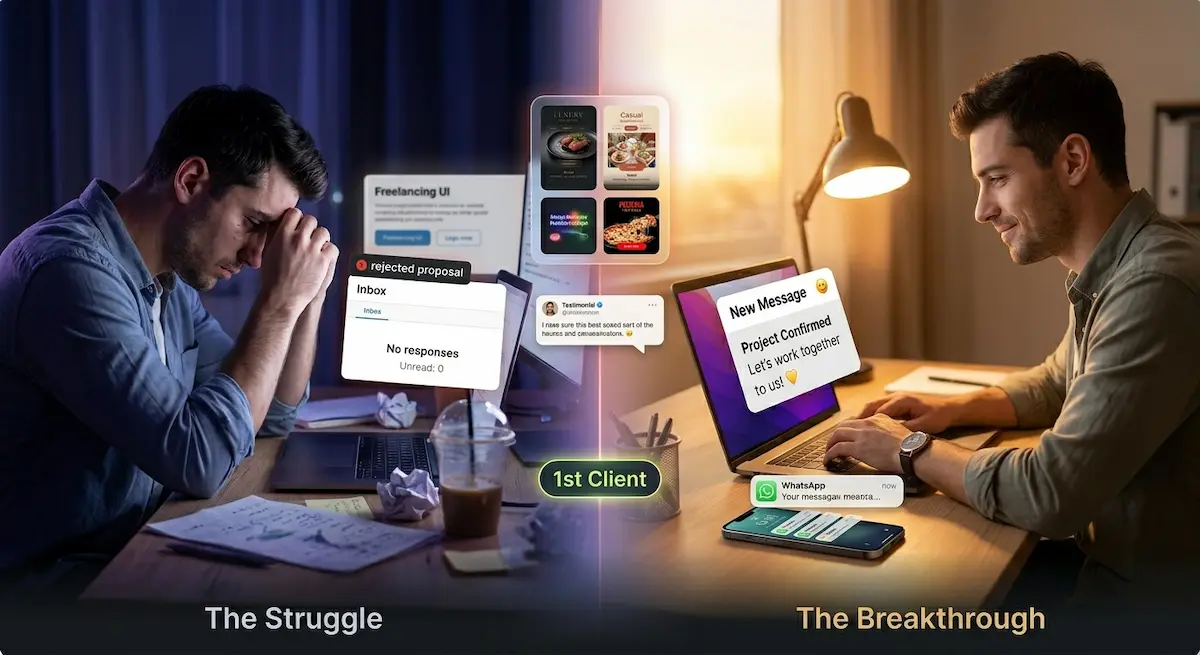
Introduction
Nobody talks about how hard the beginning actually is.
They talk about the freedom. The flexibility. The ability to work from anywhere, choose your clients, set your own rates. They show you the Upwork profiles with hundreds of five-star reviews and $200,000 in earnings and they make it look like a path you simply walk down.
They do not talk about the part before that. The part where you have built real things, learned real skills, and worked harder than most people around you — and still cannot get a single client to reply to your message.
I lived that part for longer than I want to admit.
I am a fullstack developer based in Morocco. I spent 3.5 years building, learning, and improving daily — Java, Spring, React, Laravel, Inertia.js, Vue.js, Next.js, Three.js — while applying for jobs that never called back and sending freelance proposals that disappeared into silence. I built a portfolio with Three.js animations that made a planet orbit and a universe breathe with stars. I sent 31 cold DMs to local restaurants in one week promoting a template I had built. One replied. Then ghosted.
I am not writing this from the other side of a success story. I am writing it from the middle — with hard-earned clarity about what actually moves the needle and what just feels productive while changing nothing.
This is what I know.
1. The Real Reason You Are Not Getting Clients
Before tactics, the honest diagnosis.
Most developers without clients have one of three problems. Sometimes all three.
Visibility. The right people have never seen your work. You built something impressive and shared it with your existing circle — friends, LinkedIn connections, maybe a few colleagues. Twenty likes. No clients. The problem is not the work. The problem is that the people who would pay for it do not know it exists.
Wrong channel. You are knocking on doors that do not open the way you are knocking. Upwork with zero reviews is one of the hardest places to start as a developer. The platform is built on social proof. Without reviews you are invisible against competitors with hundreds of them. Cold DMs to businesses that do not buy through DMs produce silence regardless of how good your work is.
Unclear offer. You are presenting yourself as a developer — a category — rather than a solution to a specific problem. "I am a fullstack developer" tells a potential client what you are. It does not tell them what changes in their life or business when they hire you. Every client buys a result, not a skill set.
Identifying which of these three problems is your primary blocker determines everything that follows.
2. The Catch-22 of Freelancing With No Reviews
The cruelest truth about freelancing without a reputation is this: you need work to get reviews and you need reviews to get work.
Platforms like Upwork, Fiverr, and most freelance marketplaces are built around social proof. A client choosing between a developer with fifty five-star reviews and a developer with none will choose the reviews almost every time — even if your portfolio is stronger. Risk is the dominant factor in a stranger's hiring decision, and reviews reduce perceived risk.
This catch-22 is real. But it is not unsolvable. The solution is to stop trying to win on a playing field designed for people who already have what you are trying to get.
You do not break the catch-22 by competing harder on the same platform. You break it by going somewhere the catch-22 does not exist.
3. Where the Catch-22 Does Not Exist
The catch-22 exists on platforms. It does not exist in relationships.
A person who knows you, has seen your work, or has been referred to you by someone they trust does not need fifty reviews to hire you. They already have the social proof they need — it came from a human being they know, not a number on a platform.
This is why your first client almost never comes from a cold platform. It comes from your network, from content you have published, or from a warm introduction.
Your existing network is larger than you think.
Write a list of every person you know who runs a business, works at a company that builds digital products, or knows someone who might need what you do. Former classmates. Professors. Family contacts. Former colleagues from internships. People you have helped in the past.
You are not asking them for a job. You are telling them what you do specifically and asking one question: do you know anyone who might need this?
A referral from a trusted contact converts at a rate that no cold outreach strategy can match. One genuine conversation in your existing network is worth a hundred cold DMs to strangers.
Warm outreach beats cold outreach at every stage.
When you reach out to a potential client you have no relationship with, the difference between cold and warm outreach is the difference between a stranger knocking on your door and a friend calling ahead.
Warm outreach means you have given something before you ask for anything. You commented genuinely on their work. You shared something they created. You answered a question they asked publicly. By the time you reach out directly, you are not a stranger — you are someone they recognize.
This takes longer than sending a hundred cold DMs in an afternoon. It converts at a rate that makes the time investment worthwhile.
4. Your First Client Is Not Your Best Client — It Is Your Most Important One
The goal of your first freelance client is not to make money. The goal is to create proof.
A testimonial from a satisfied client does more for your ability to attract future clients than any portfolio piece, any platform profile, or any cold outreach strategy. It converts a stranger's dominant question — can I trust this person to deliver? — from a risk into a resolved concern.
This means your first client deserves your absolute best work. Not because they are paying you the most — they probably are not. But because what they say about you afterward will either open doors or close them.
Under-promise and over-deliver on the first project. Communicate more than you think is necessary. Deliver before the deadline if possible. Ask for feedback during the project, not just at the end. When the project is complete, ask directly and specifically for a testimonial — not a vague positive comment, but a specific statement about what problem you solved and how you solved it.
A testimonial that says "great developer, highly recommend" is worth something. A testimonial that says "he built our artist portfolio with a complete admin dashboard, delivered it on time, and handled every revision with patience — our clients constantly compliment the design" is worth considerably more.
Specificity in social proof reduces perceived risk. Reduced perceived risk converts prospects into clients.
5. The Portfolio Problem Nobody Talks About
Most developer portfolios have the same problem: they are designed to impress other developers, not to convert clients.
They show technology choices, GitHub commit counts, Lighthouse scores, and architecture diagrams. They use words like "fullstack," "scalable," "clean code," and "SOLID principles."
A business owner looking for someone to build their website does not know what SOLID means. They do not care about your Lighthouse score. They care about one thing: will this person make me something that works, looks professional, and brings me customers?
Your portfolio needs to answer that question in the first ten seconds.
This means leading with results, not technologies. Not "built with React, Laravel, and Inertia.js" but "a complete artist platform with online gallery, admin dashboard, and dark mode — delivered in three weeks." Not "implemented RTL support with i18next" but "fully bilingual in Arabic and French, built for Moroccan and international audiences."
The technology is the how. The result is the what. Clients buy the what.
Show your work visually. A screen recording of your Three.js portfolio in motion communicates more in ten seconds than three paragraphs of technical description. A before-and-after comparison of a client's web presence communicates value immediately and memorably.
And solve the visibility problem ruthlessly. A portfolio that nobody can find is not a portfolio. It is a private collection. Fix your SEO. Get a domain name. Share your work on the platforms where your potential clients spend time — not just the platforms where developers spend time.
6. Pricing Your First Projects
Pricing without a reputation is genuinely difficult. Price too high and you lose to competitors with proven track records. Price too low and you attract clients who do not value your work and set a ceiling that is hard to raise later.
The framework that works at the beginning is not to price against other developers. It is to price against the alternative your client would otherwise pay.
A local restaurant owner in Morocco who needs a website would otherwise pay a local agency between 3,000 and 8,000 MAD for a generic WordPress site with no customization and no ongoing support. Your React template with multilingual support, PWA capability, and WhatsApp integration at 2,500 MAD is not cheap — it is exceptional value compared to the real alternative.
An independent artist in Europe who needs a portfolio would otherwise pay a freelance designer and developer between €1,500 and €3,000 for a custom site. Your fullstack Laravel portfolio with admin dashboard at €600 is not underpriced. It is positioned correctly against the market alternative.
Stop comparing your prices to Fiverr listings. Compare them to what your specific client would actually pay if you did not exist.
And resist the temptation to offer the first project for free in exchange for a testimonial. Free work attracts clients who do not value your work and produces testimonials from people who would never have paid anyway. Charge something — even if it is below your eventual rate. Paid work creates a different relationship than charity.
7. Platforms That Actually Work Without Reviews
Not all freelance platforms have the same review dependency. Some are better suited to developers without established reputations.
Contra — a portfolio-forward platform where your work quality matters more than review count. Better for creative developers whose work speaks visually.
Malt — strong in France and French-speaking markets including Morocco. Less dominated by review count than Upwork. Worth building a profile on if your target market includes French-speaking businesses.
LinkedIn — underused as a client acquisition tool by most developers. Publishing genuine technical content consistently builds visibility with business owners and decision-makers who would never find you on a freelance platform. One post that resonates can generate more inbound interest than a month of cold outreach.
Instagram and Twitter/X — where independent artists, musicians, photographers, and creative businesses actually spend time. If your target clients are creatives, this is where they live. Screen recordings of your work, behind-the-scenes of your build process, and honest posts about your craft reach audiences that no freelance platform touches.
Direct outreach to warm targets — not cold DMs to strangers but thoughtful outreach to businesses whose work you genuinely admire and whose website you can specifically improve. A message that says "I noticed your menu is not mobile-optimized and I built a restaurant template that solves exactly this — here is a demo" is a different conversation than "I am a developer available for hire."
8. Content as the Long Game
Everything I have described so far is about finding your first client. Content is about never having to search this hard again.
When you write about what you build, teach what you know, and document problems you have solved — you create assets that work for you continuously without additional effort. A blog post about RTL support in React that ranks on Google brings developers to your site every day. Some of them need a developer. Some of them need a template. Some of them refer someone they know.
Content converts strangers into warm prospects before you ever speak to them. By the time someone contacts you through your website after reading your blog, they already trust you. The sales conversation is fundamentally different from cold outreach.
The developers who stop struggling for clients are almost always the ones who made content a consistent habit — not a project they completed once and abandoned.
You do not need to write perfectly. You need to write honestly and specifically about real problems you have actually solved. That combination beats polished generic content every time because it is rare.
9. The Mental Game
I want to be honest about something that most freelancing guides skip entirely.
The period between having real skills and having real clients is genuinely difficult. Not just practically difficult — emotionally difficult.
You watch people with less skill get opportunities you cannot access. You send proposals into silence. You build things nobody sees. You question whether the problem is your skills, your pricing, your communication, your location, or something unfixable about your situation.
Most of the time the problem is none of those things. The problem is that building a reputation takes time and the gap between deserving clients and having clients is real — and it is filled with work that feels invisible because the results are delayed.
The developers who get through this period share one characteristic. They keep building and shipping regardless of immediate return. Not because they are disciplined in some superhuman way — but because they genuinely love what they do and cannot stop even when it makes no financial sense to continue.
If you are still building, still learning, still shipping after months or years without the financial return you deserve — that persistence is not desperation. It is proof of something real. The market catches up to genuine effort. It is slower than it should be. But it catches up.
Conclusion
Getting your first freelance client with no reviews is not a tactics problem. It is a positioning, visibility, and patience problem.
The tactics matter — warm outreach over cold, results-focused portfolio over technology showcase, platforms where social proof matters less, content that builds trust before the first conversation. But tactics without the right positioning produce frustration, and positioning without visibility produces silence.
Fix how the world sees you before you fix how you reach the world.
And remember that every developer with a full client roster was once exactly where you are — with real skills, no reviews, and no clear path forward. The path was not given to them. They built it the same way they build everything else.
One decision at a time. One client at a time. One shipped thing at a time.
Dywan Dev is built by a solo developer who lived every word of this guide. If you need a web developer who understands your situation because he has been there — or if you need a production-ready template that gets your project launched fast — let's talk.